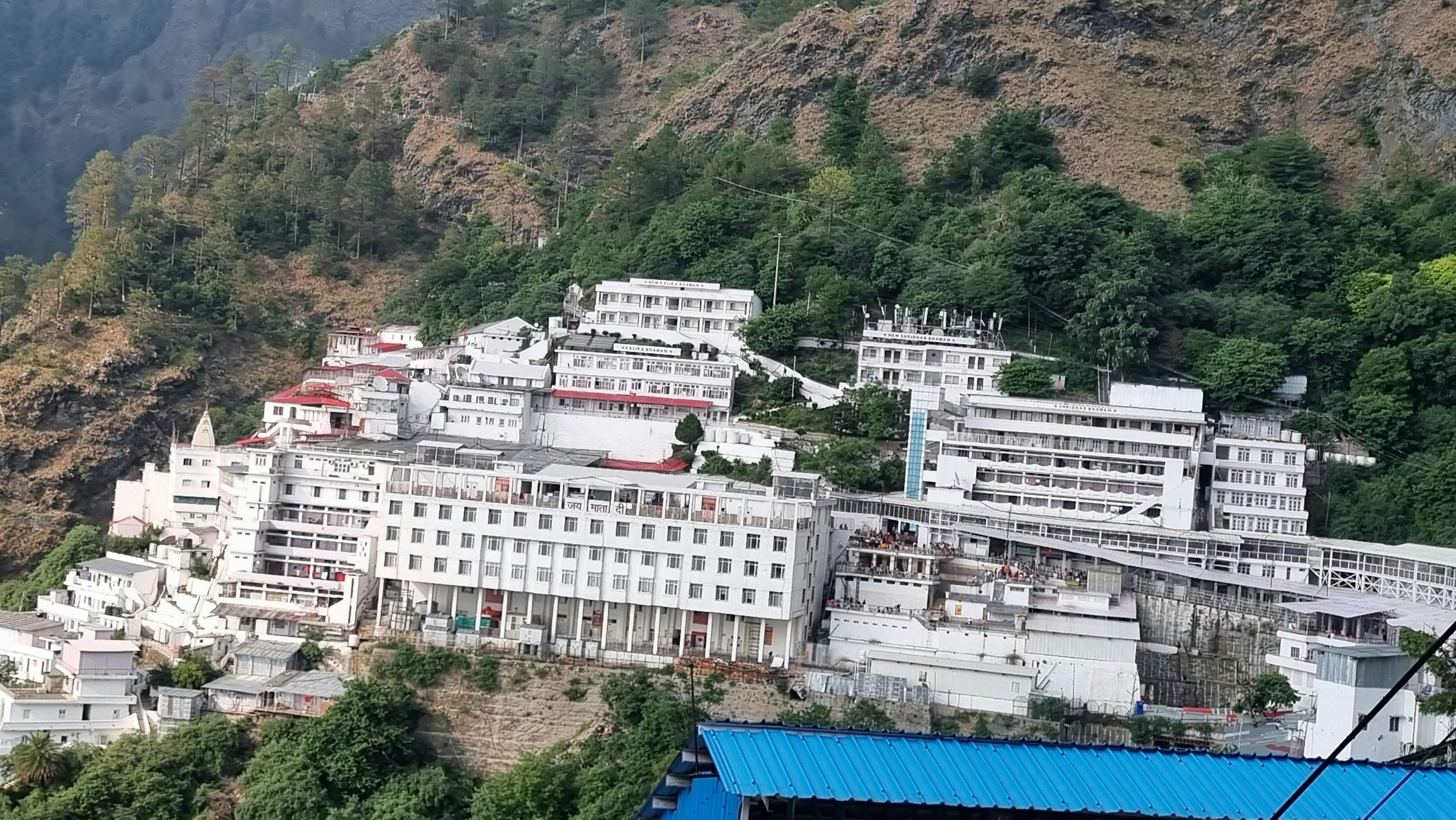
"Jai Mata Di" — these sacred words fill every devotee's heart with profound devotion. Maa Vaishno Devi Temple is one of India's holiest and most popular Shaktipeeths, nestled in the lap of the sacred Trikuta Parvat at an altitude of 13 km above Katra in Jammu & Kashmir. It is believed that Maa Vaishnavi is the combined divine incarnation of three goddesses — Mahalakshmi, Mahakali, and Mahasaraswati.
Inside the sacred cave of the Bhavan, Maa is enshrined in Her three divine Pindi forms — this is the supreme manifestation of Maa Vaishno Devi. Each year, millions of devotees undertake this holy pilgrimage, and it is a firm belief that Maa Herself sends a "bulava" (divine call) to Her devotees — no one can reach Her sacred abode without Her blessing.
Quick Information
- Main Deity: Maa Vaishnavi (Vaishno Devi)
- Location: Katra, Reasi District, J&K
- Altitude: 5,200 ft (1,584 meters)
- Mountain: Trikuta Parvat
- Base Camp: Katra
- Total Yatra: 13 km from Katra
Darshan Timings
The Complete Story of Maa Vaishno Devi
The story of Maa Vaishno Devi dates back to the Treta Yuga. It is a beautiful tale of devotion, divine miracles, and Maa's infinite grace. Let us walk through this sacred journey step by step —
The Divine Incarnation: During Treta Yuga, when the demons' atrocities reached their peak, the three goddesses — Mahalakshmi, Mahakali, and Mahasaraswati — combined their divine energies to incarnate as a beautiful young girl. She emerged from the Ratnakar Sagar on the southern shores of India. From her very childhood, she had Vaishnavi (Vishnu-devoted) thoughts, hence she was named "Vaishnavi."
Meeting with Lord Ram: When Lord Ram passed through Rameshwaram during His exile, He met the young Vaishnavi. She expressed her wish to marry Him. Lord Ram promised her that marriage would only be possible in the Kali Yuga when He would incarnate as "Kalki." Until then, He instructed her to perform tapasya on the Trikuta Parvat.
Tapasya on Trikuta Parvat: Following Lord Ram's instructions, Maa Vaishnavi journeyed to the Trikuta mountain near Jammu and began severe tapasya in a cave dedicated to Lord Vishnu. This cave is famous today as "Adi Kumari" (Ardhkuwari) — where Maa meditated for 9 long months.
Shridhar's Bhoj (Feast): Approximately 700 years ago in Kali Yuga, in the village of Hansali near Katra, lived a devout Brahmin named Shridhar. He was Maa's most ardent devotee. Inspired by Maa, he once organized a "Kanya Bhoj" (feast for young girls) during Navratri, but he had no resources to do so. Maa Vaishnavi Herself appeared before him as a young girl and promised to arrange everything.
Bhairon Nath's Insult: The entire village along with the tantric Bhairon Nath and his 360 disciples arrived at the bhoj. Bhairon demanded meat and wine, but the young Vaishnavi refused. Enraged, Bhairon tried to capture her — but Maa, taking her divine form, vanished and headed toward the Trikuta Parvat.
The Miracle of Ban Ganga: While running, Maa felt thirsty and pierced the earth with her arrow (baan) — instantly, a sacred stream of holy water emerged. This is today known as "Ban Ganga." Here, Maa washed her hair and drank water. Every devotee performs achaman (ritual sipping) in this sacred stream before proceeding further.
Charan Paduka — Maa's Divine Footprints: Further along the path, Maa paused at a spot and looked back to see how far Bhairon was. The marks of her sacred feet remain etched on a stone at this place to this day — known as "Charan Paduka."
Ardhkuwari Cave (Adi Kumari): Maa entered the narrow Ardhkuwari cave and performed tapasya for 9 months — just like a child remains in a mother's womb for 9 months. This is why passing through this narrow cave is called "Garbh Joon" — symbolizing a second birth. Devotees believe their sins are washed away by passing through this sacred cave.
Bhairon's Beheading and Salvation: When Bhairon finally located Maa at Ardhkuwari, she appeared in her fierce Mahakali form and severed his head from his body with her trishul. Bhairon's head landed 3 km away in what is now called Bhairon Valley. Before dying, Bhairon repented and begged for moksha (liberation).
Maa's Boon to Bhairon: Pleased with his repentance, Maa granted him a boon — that her yatra would never be considered complete until devotees visit Bhairon's shrine as well. This is why every Vaishno Devi pilgrim visits the Bhairon Valley after Bhavan darshan. The Bhairon Nath temple stands there to this day.
Shridhar's Divine Darshan: Meanwhile, Shridhar had lost consciousness. Maa appeared in his dream and revealed the location of her sacred cave. Shridhar reached the Bhavan and beheld all three Pindi forms of Maa. Maa blessed him, saying that his descendants would forever be her main priests — and to this day, Shridhar's descendants are the official priests of the Bhavan.
Enshrined as Three Pindis: Even today, Maa resides in the sacred cave of the Bhavan in the form of three divine Pindis — Mahakali, Mahalakshmi, and Mahasaraswati. This is the supreme and most sacred form of Maa Vaishno Devi.
Three Pindi Forms at the Bhavan
Inside the sacred cave of the Bhavan, Maa Vaishno Devi is not enshrined as an idol, but in the form of three natural rock pindis (formations). These three pindis represent Maa's three divine shakti forms —
🔱 Mahakali
The pindi on the right. Goddess of strength, courage and destroyer of evil. Dark-colored pindi.
🪷 Mahalakshmi
The central pindi. Goddess of wealth, prosperity and fortune. Golden-yellow radiance.
📖 Mahasaraswati
The pindi on the left. Goddess of knowledge, wisdom and arts. White-luminescent radiance.
Yatra Registration
Before starting the Maa Vaishno Devi yatra, obtaining an RFID Yatra Slip is mandatory. The yatra cannot begin without this slip.
- 🎫 Online Registration: Through the official Shri Mata Vaishno Devi Shrine Board (SMVDSB) website
- 🏢 Offline Registration: Yatra Registration Counter near Katra Bus Stand (free of cost)
- 📱 Aadhaar Card Required: Valid government-issued ID proof needed for registration
- ⏰ Time Limit: No strict time limit after obtaining the slip — though starting the yatra soon is recommended
- 🔄 Ban Ganga Check Point: Your RFID slip is scanned here
Two Yatra Tracks (Old & New)
There are two main routes from Katra to the Bhavan. Both routes start from Ban Ganga and merge at Ardhkuwari.
🛤 Old Track
- Distance: 13 km (Katra to Bhavan)
- Incline: Steeper climb
- Time: 6-8 hours (on foot)
- Traditional route — stairs and narrower
- Ponies, palki, pitthu available
- Connected to Himkoti Cafeteria
🛣 New Track
- Distance: 14.5 km (slightly longer)
- Incline: Less steep
- Time: 5-7 hours (on foot)
- Modern route — wider and easier
- Pedestrians and battery cars only
- More rest stops available
Major Stops Along the Yatra
The yatra from Katra to the Bhavan has several important stops, each with its own spiritual significance —
🚩 Darshani Darwaza Katra - Start
The official starting point of the yatra. Your RFID slip is checked here, and devotees begin their journey with the chant of "Jai Mata Di."
🌊 Ban Ganga ≈1 km from Katra
The sacred stream created by Maa's arrow. It is believed that bathing here washes away all sins. Every devotee performs achaman in this holy stream.
👣 Charan Paduka ≈2 km from Katra
The sacred footprints of Maa imprinted on a stone. This is the spot where she paused and looked back. Devotees offer flowers and prasad here.
🕳 Ardhkuwari (Adi Kumari) ≈6 km from Katra
The main midway stop. Maa meditated here for 9 months. Passing through the narrow "Garbh Joon Cave" is considered like a second birth. This stop is the most challenging part of the journey.
⛰ Himkoti ≈9.5 km from Katra
A beautiful rest area with a cafeteria and seating arrangements. Offers a stunning view of Katra and the Himalayan ranges from here.
🛕 Sanjichhat ≈11.5 km from Katra
The helicopter landing point and a major stop just 1.5 km before the Bhavan. From here, an easy walking path leads to the Bhavan.
🕉 Bhavan (Main Temple) 13 km from Katra
The divine abode of Maa. Darshan of the three Pindi forms in the sacred cave — Mahakali, Mahalakshmi, and Mahasaraswati. The sacred "Jai Mata Di" chant echoes here continuously.
Bhairon Nath Temple — Essential Part of the Yatra
The Maa Vaishno Devi yatra is considered incomplete without visiting Bhairon Nath — Maa Herself gave this divine boon. This is where Maa slayed Bhairon, and after his death, she granted him moksha (liberation) by her infinite grace.
📍 Location: ≈2.5 km above the Bhavan in Bhairon Valley (total altitude ≈6,583 ft)
📍 How to Reach: By foot (≈1-1.5 hours) or by ropeway (5 minutes, with fee)
Bhairon Nath's head is worshipped here in the form of a rock. The yatra is considered complete only after visiting this temple — only then are the full blessings of Maa attained.
Prohibited Items During Yatra
Maa Vaishno Devi is purely Vaishnavi — a symbol of sattvic and vegetarian living. Therefore, the following items are strictly prohibited during the yatra —
How to Reach Katra
Katra (base camp) is excellently connected to all major cities of India. Today, with the Vande Bharat Express and many other facilities, the journey has become very convenient.
Yatra Facilities
The Shri Mata Vaishno Devi Shrine Board (SMVDSB) provides several modern facilities for the convenience of pilgrims —
- 🐎 Pony / Horse Service: For pilgrims unable to walk
- 🪑 Palki (Doli): For elderly and unwell pilgrims (carried by 4 bearers)
- 🎒 Pitthu Service: Small children can be carried on shoulders
- 🚗 Battery Car Service: Available on the New Track from Ardhkuwari to Sanjichhat
- 🏨 Accommodation: SMVDSB Yatri Niwas (Katra, Ardhkuwari, Sanjichhat, Bhavan) — Advance booking essential
- 🍽 Eateries: Pure sattvic food — available every 1-2 km along the route
- 🏥 Medical Facilities: Multiple primary health centers along the route, oxygen cylinders available
- 🚿 Cloak Rooms: Safe storage of belongings at every major stop
- 🚻 Toilets: Clean toilets available every 500 meters
Temple Location
The exact location of Maa Vaishno Devi Bhavan — zoom in on the interactive map below or open it in Google Maps for navigation.
Frequently Asked Questions
Yes, the RFID Yatra Slip is mandatory. It can be obtained online through the SMVDSB website or offline (free of cost) at the registration counter near Katra Bus Stand. There is no strict time limit after obtaining the slip — though it's best to start the yatra as soon as possible.
The trek from Katra to Bhavan is 13 km (Old Track) or 14.5 km (New Track). On foot, it takes 6-8 hours. The climb is moderate to difficult, especially on the Old Track. Pony, palki, and helicopter services are also available.
Maa Vaishno Devi herself decreed that her yatra would be incomplete without visiting Bhairon. Therefore, every devotee visits Bhairon Valley after Bhavan darshan. The Bhairon temple is ≈2.5 km above the Bhavan. It can be reached on foot or by ropeway.
March to October is the best time to visit. The crowds are largest during Navratri (March-April and September-October). In winter, snowfall makes the journey more difficult, but seeing the temple covered in snow has its own divine beauty.
Yes, Maa Vaishno Devi is purely Vaishnavi. Beyond Katra, in the entire yatra area, non-vegetarian food, eggs, alcohol, onion, garlic, and tobacco are strictly prohibited. Only sattvic vegetarian food is available throughout the journey.
Mobile phones and cameras can be carried along the yatra route, but they are strictly prohibited inside the sacred cave of the Bhavan. Outside the temple complex, all items must be deposited in cloak rooms. This facility is free of charge.
No — only post-paid SIM cards from other states work in Jammu & Kashmir. Pre-paid SIM cards from other states do NOT function. If you have a pre-paid SIM, it's best to get a local J&K SIM. BSNL and Jio are considered to have the best network coverage on the mountain. Coverage may weaken in higher altitude areas.
Helicopter service can be booked online through the official SMVDSB website (maavaishnodevi.org). Booking should be done well in advance during peak season. It operates from Katra to Sanjichhat — reaching in just 8-10 minutes. It is a blessing for elderly and differently-abled pilgrims.
Ardhkuwari is a narrow cave where Maa meditated for 9 months. Passing through this narrow cave is called "Garbh Joon" — considered equivalent to a second birth. It is believed that those who pass through have their sins washed away and attain a new life.
SMVDSB Yatri Niwas are available at Katra, Ardhkuwari, Sanjichhat, and Bhavan. These offer affordable and clean facilities. Many private hotels are available in Katra. Advance booking is essential during peak season and Navratri — otherwise, finding accommodation becomes difficult.
On foot, the yatra from Katra to Bhavan takes 6-8 hours, and including Bhairon darshan, you should plan for a 2-3 day yatra. By helicopter, it can be completed in a single day. Pony or palki takes 5-6 hours.
Absolutely. Pitthu service allows small children to be carried on shoulders. For the elderly, palki (carried by 4 bearers) or the helicopter service is most suitable. Battery car service is also available on the New Track. Heart patients and those with serious illnesses should consult a doctor first.
Official Website
For yatra registration, helicopter booking, accommodation booking, and live updates, please visit the official Shri Mata Vaishno Devi Shrine Board website.
maavaishnodevi.org