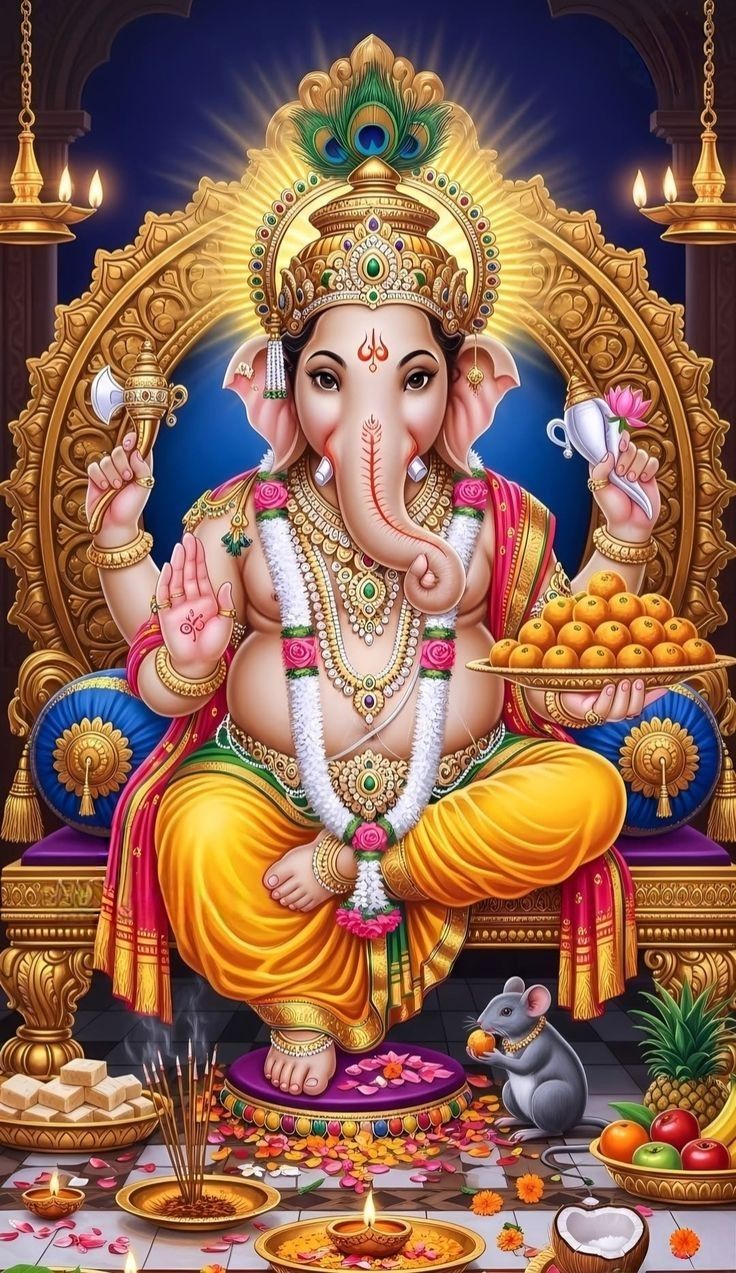
Lord Ganesha is the "First Worshipped Deity" in Sanatan Dharma. Any auspicious work, puja, ritual, or yajna begins with his name. He is the son of Lord Shiva and Mother Parvati, and the younger brother of Kartikeya. His vahana is a small mouse (mushak), which symbolizes victory over ego.
Ganesha is called Vighnaharta (Remover of Obstacles) and Siddhivinayak (Bestower of Success). His wives are Riddhi (prosperity) and Siddhi (spiritual power), and his sons are Shubh-Labh (auspiciousness and gain). This is why in every home, "Shubh-Labh" is written — to invoke the blessings of the Ganesha family.
Ganesha's Gajmukh (elephant head) symbolizes wisdom, intellect, and discernment. His large ears convey the message of listening to everyone, his small eyes signify subtlety, and his large belly represents the capacity to digest all things. He is the "Lord of Wisdom" and the special deity of writers, students, and businessmen.
Key Information
- Father: Lord Shiva
- Mother: Mother Parvati
- Brother: Kartikeya
- Wives: Riddhi and Siddhi
- Sons: Shubh and Labh
- Vahana: Mushak (Mouse)
- Position: Universal (First Worshipped)
Major Festivals
- Ganesh Chaturthi: Bhadrapad Shukla Chaturthi
- Sankashti Chaturthi: Monthly Krishna Chaturthi
- Vinayaka Chaturthi: Monthly Shukla Chaturthi
- Angarki Chaturthi: Tuesday + Sankashti
- Ganesh Jayanti: Magh Shukla Chaturthi
- Anant Chaturdashi: Ganpati Visarjan day
Mantras
Ganesha's mantras are considered extremely powerful and quickly fruitful. Chanting these mantras at the start of any work, before exams, or in times of difficulty is highly auspicious.
Special Significance
Ganesha's status among all deities is supreme — because he is "Pratham Pujya" (the First Worshipped). Lord Shiva and Parvati themselves granted him the boon that Ganesha would be worshipped first in any auspicious work. This is why Ganesha puja is essential in weddings, housewarmings, and business openings.
Ganesha's "Gajmukh" (elephant head) holds deep spiritual meaning. The elephant head symbolizes wisdom, patience, and vastness. One tusk represents sacrifice, and the large belly demonstrates the capacity to digest all of life's good and bad. His mushak (mouse) vahana teaches that true accomplishment lies in controlling the ego (small thoughts).
The author of the Mahabharata, Veda Vyasa, asked Ganesha — "I will keep speaking, you keep writing. Do not stop in between." Ganesha set the condition that he would write only when he understood. Thus the Mahabharata was composed. This is why Ganesha is also called the "Lord of Writers".
Major Stories of Lord Ganesha
Every story of Ganesha's life is filled with devotion, wisdom, and miracles — here are some major ones —
Major Festivals (Detailed)
Ganesha's festivals are celebrated with great grandeur across India, especially in Maharashtra —
Iconography & Qualities
Ganesha's iconography is highly symbolic — every feature conveys a spiritual message —
Major Sacred Places
Ganesha temples are spread throughout India. Here are four of the most famous and miraculous sites —
Related Scriptures
The glory of Lord Ganesha is described in many sacred scriptures —
Frequently Asked Questions
Lord Shiva himself granted Ganesha the boon that in any auspicious work, puja, or ritual, he would be worshipped first. In the Earth-circumambulation contest, Ganesha proved he was the wisest by circling his parents. Since then, every work begins with "Shri Ganeshay Namah."
Mother Parvati had created a child from her sandalwood paste and breathed life into him. When Shiva returned to Kailash, the boy Ganesha stopped him at the door. The angered Shiva severed his head with his trishul. Seeing Mother Parvati's grief, Shiva instructed his ganas to bring the head of the first creature found in the north. They brought an elephant's head, which was attached to Ganesha's body.
Ganesh Chaturthi is celebrated on Bhadrapad Shukla Chaturthi (August-September) as Ganesha's birth anniversary. The 10-day festival is especially grand in Maharashtra. Idols are installed in homes and pandals, with modak bhog and aarti. On the final day (Anant Chaturdashi), the immersion (visarjan) takes place with chants of "Ganpati Bappa Morya."
Modak is a sweet dish made from rice or refined flour with a coconut-jaggery filling. It is believed that Mother Parvati made the first modak for Ganesha with her own hands. The outer covering of the modak symbolizes hard work, and its inner sweetness represents the sweet fruit. This is why the tradition is to offer 21 modaks to Ganesha.
The mouse (mushak) symbolizes ego and petty thinking. Ganesha's massive body and small vahana convey the message that no matter how great you are, true accomplishment lies in controlling the ego. The mouse is active at night — symbolizing the search for knowledge even in darkness (ignorance). According to legend, the mouse was once a gandharva named Krauncha.
Once, Parshuram came to Kailash to meet Shiva. Ganesha stopped him because Shiva was resting. The angered Parshuram struck with his parshu (axe). Since the axe had been given by Shiva himself, Ganesha respectfully took the blow upon himself — which broke one of his tusks. From then on, he became "Ekdant." In another story, when writing the Mahabharata, when his pen broke, he broke off his tusk to continue writing.
Ganesha worship at home is simple — after a morning bath, light a lamp before Ganesha's idol or image, offer sindoor, red flowers (hibiscus), and 21 durva (a type of grass), then chant "ॐ गं गणपतये नमः" 108 times. Offer modak or laddoo as bhog. Wednesdays and Sankashti Chaturthi are especially auspicious. Always perform Ganesh vandana before starting any new work.
Once, a demon named Analasura poisoned the entire world. Ganesha swallowed him, but a great burning sensation began in his stomach. 88 sages fed him 21 sprigs of durva each — which soothed the burning. From then on, durva became most beloved to Ganesha. It is believed that offering 21 durva yields the merit of a thousand worships.
Ashtavinayak refers to the 8 self-manifested Ganesha temples in Maharashtra — Morgaon (Mayureshwar), Theur (Chintamani), Siddhatek (Siddhivinayak), Ranjangaon (Mahaganpati), Ozar (Vighneshwar), Lenyadri (Girijatmaj), Mahad (Varadvinayak), and Pali (Ballaleshwar). Visiting all eight temples is considered extremely meritorious.
After the 10 days of Ganesh Chaturthi, on Anant Chaturdashi, the Ganesh idol is immersed in water. This conveys the message that nothing is permanent — the cycle of creation, preservation, and destruction continues. The idol returns to the clay and merges with nature. Today, eco-friendly clay idols and symbolic visarjan are encouraged for environmental protection.
Yes, on the day of Bhadrapad Shukla Chaturthi (Ganesh Chaturthi), sighting the moon is considered forbidden. According to the Purana, the moon once laughed at Ganesha, and Ganesha cursed: "Whoever sees you on this day shall face slander." If one accidentally sees the moon, reading or listening to the Syamantak gem story grants release from the curse.
Worshipping Ganesha has many benefits — removal of all obstacles, increase in wisdom and knowledge, success in work, business prosperity, success in exams, peace in family disputes, and happiness-prosperity. Housewarmings, weddings, business openings — every auspicious work begins with Ganesha worship. His consorts Riddhi-Siddhi and sons Shubh-Labh — everything is bestowed.