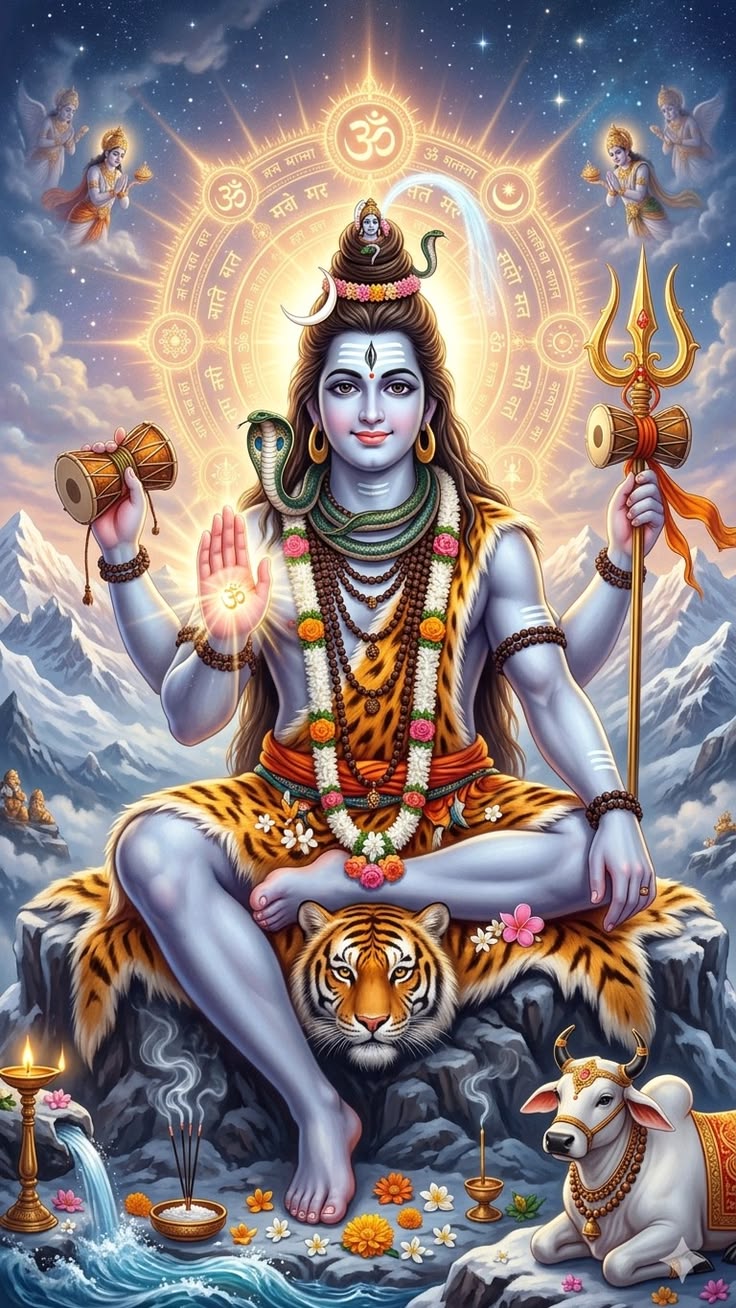
Lord Shiva is worshipped as the Destroyer and Benevolent God among the Trinity (Trimurti). He is known as Yogeshwar, Mahadev, and Nataraja. Shiva's form embodies simplicity and asceticism — matted locks (jatajoot), the Ganga, the moon, serpents around his neck, and a body smeared with sacred ash symbolize his life of detachment. He resides on Mount Kailash and is the consort of Mother Parvati, and father of Ganesha and Kartikeya.
Shiva's philosophy is based on non-violence, restraint, and devotion. He is easily pleased by his devotees, earning him the name Bholenath (the innocent lord). Just a pot of water and a bilva leaf are enough to please him. During the cosmic ocean churning (Samudra Manthan), Shiva drank the deadly halahala poison to save the universe — which turned his throat blue and gave him the name Neelkanth.
In his Nataraja form, Shiva is the lord of the cosmic dance — symbolizing creation, preservation, and destruction. He is the supreme deity of yogis and remains in deep meditation as Mahayogi. In the Shaiva tradition, he is the guide on the path of supreme knowledge, detachment, and liberation (moksha).
Key Information
- Consort: Mother Parvati
- Sons: Ganesha & Kartikeya
- Abode: Mount Kailash
- Vahana: Nandi (bull)
- Weapons: Trishul, Damaru, Pashupatastra
- Forms: Shivling, Nataraja, Ardhanarishvara
Major Festivals
- Mahashivratri: Phalgun Krishna Chaturdashi
- Sawan Somvar: Mondays of Shravan
- Kanwar Yatra: Shravan month
- Pradosh Vrat: Every Trayodashi
- Masik Shivratri: Monthly Krishna Chaturdashi
- Nag Panchami: Shravan Shukla Panchami
Mantras
Chanting Shiva's divine mantras is considered highly auspicious. These mantras bring peace to the mind, health to the body, and grant the soul the path to liberation.
Special Significance
Lord Shiva is considered the Adi Dev (Primordial God) of Sanatan Dharma — without beginning or end. He is Swayambhu (self-manifested) and existed before creation itself. In the Vedas, he is called "Rudra" — destroyer for the wicked, and benevolent for his devotees.
Shiva's other name is "Bholenath" — because he is extremely simple and easily pleased. Just water and bilva leaves are enough to please him. As the saying goes — "Shivo bhutva Shivam yajet" — One must become like Shiva to truly worship Shiva.
Shiva's third eye symbolizes wisdom, discernment, and destructive power. With it, he reduced Kamadeva to ashes. His Nataraja form represents the cosmic dance "Tandava" — encompassing creation, preservation, and destruction of the universe.
Major Stories of Lord Shiva
The stories of Lord Shiva are countless — each one carrying a message of devotion, sacrifice, and divinity. Here is a brief account of the most prominent stories —
Major Festivals (Detailed)
Festivals associated with Lord Shiva are celebrated with great devotion across India and Nepal. Each festival has its own special significance —
The Twelve Jyotirlingas
The 12 Jyotirlingas of Lord Shiva are located across various sacred sites in India. These are considered the Swayambhu (self-manifested) sacred forms of Shiva. Each Jyotirlinga has its own unique story and glory. It is believed that one who visits all 12 Jyotirlingas attains moksha (liberation).
🏔 Panch Kedar
In the Garhwal Himalayas of Uttarakhand, the Panch Kedar are five sacred shrines of Shiva. After the Mahabharata war, when the Pandavas sought forgiveness from Shiva, he assumed the form of a bull and disappeared into the ground. His body parts emerged at five locations — these are known as the Panch Kedar.
Hump
Arms
Face
Navel
Locks
Iconography & Qualities
Lord Shiva's iconography is wonderfully symbolic. Every emblem he carries represents profound spiritual meaning —
Major Sacred Places
There are countless temples of Lord Shiva across India and Nepal. Here are some of the most prominent and sacred sites that every Shiva devotee should visit at least once in their lifetime —
Related Scriptures
The glory of Lord Shiva is described in many sacred scriptures. These texts elaborate on Shiva-tattva, his leelas, and his devotion —
Frequently Asked Questions
Mahashivratri is celebrated on the Krishna Chaturdashi of Phalgun/Magh month (February-March). It is believed that on this very night, Shiva and Parvati were married and Shiva performed the Tandava dance. Devotees observe fasts, hold night vigils, and perform the Char Pahar Puja (four-part prayer). It is the greatest occasion of Shiva devotion.
Shiva is extremely simple, innocent, and easily pleased. Merely offering water and bilva leaves is enough to please him — no matter who the devotee may be. He doesn't require complex rituals or elaborate mantras. Because of this innate simplicity, he is called "Bholenath" (the innocent lord).
The Shivling symbolizes the formless aspect of Shiva. "Linga" means "mark" or "symbol" — representing the origin of the universe. It signifies the non-dual union of Purusha (Shiva) and Prakriti (Shakti). The Shivling is considered the center of cosmic energy.
Bilva leaves (Bel Patra) are extremely dear to Shiva. The three leaves symbolize his three eyes or the three Gunas (Sattva, Rajas, Tamas). It is believed that offering even a single bilva leaf yields the merit of a thousand worships. They are essential during Monday vrat, Pradosh vrat, and Shivratri.
The 12 Jyotirlingas are — Somnath (Gujarat), Mallikarjuna (Andhra Pradesh), Mahakaleshwar (Ujjain), Omkareshwar (Madhya Pradesh), Kedarnath (Uttarakhand), Bhimashankar (Maharashtra), Kashi Vishwanath (Varanasi), Trimbakeshwar (Nashik), Vaidyanath (Deoghar), Nageshwar (Dwarka), Rameshwaram (Tamil Nadu), and Grishneshwar (Ellora).
The Panch Kedar are five sacred shrines of Shiva in the Garhwal Himalayas of Uttarakhand — Kedarnath (hump), Tungnath (arms), Rudranath (face), Madhyamaheshwar (navel), and Kalpeshwar (matted locks). After the Mahabharata war, the Pandavas sought Shiva's darshan here to absolve themselves of sins.
Nataraja is Shiva's dancing form, performing the cosmic dance "Tandava." This dance is not just destruction — it encompasses all five cosmic acts: creation, preservation, destruction, illusion (maya), and liberation (moksha). The Nataraja icon — with fire, damaru, the abhaya mudra, and the raised foot — is full of spiritual symbolism.
Worshipping Shiva at home is very simple — after a morning bath, light a lamp before the Shivling or Shiva's image, offer water and bilva leaves, and chant "ॐ नमः शिवाय" 108 times. Observe special worship on Mondays and Pradosh vrat. Perform Panchamrit Abhishek with milk, curd, ghee, honey, and sugar. Offer fruits or sweets as bhog.
The Mahamrityunjaya Mantra — "ॐ त्र्यम्बकं यजामहे..." — is considered Shiva's most powerful mantra. It is the mantra that liberates one from death, disease, and fear. Sage Markandeya conquered death by chanting this mantra. During illness, hardship, or for protection of life, chanting it 108 times is considered extremely effective.
Shiva is also called the "Shmashan Vasi" (dweller of cremation grounds). The Shmashan symbolizes the impermanence of the world — where the true secret of life is revealed. This form of Shiva delivers a message of detachment and liberation. His meditation sites (Kailash, Amarnath, Kedarnath, etc.) are places of his solitary tapasya and yoga.
Yes, Shiva is considered the "Adi Yogi" — the first guru of yoga. He imparted the knowledge of yoga to the Saptarishis (seven sages). Shiva's own form is that of a yogi — absorbed in meditation, smeared with ash, in deep dhyana. This is why yogis and saints consider Shiva their supreme deity. Hatha Yoga, Kundalini Yoga, and Tantra — all are said to have originated from Shiva.
Shiva has countless forms, but the major ones are — Shivling (formless aspect), Nataraja (the cosmic dancer), Ardhanarishvara (Shiva-Parvati union), Neelkanth (poison-drinking form), Dakshinamurti (guru form), Bhairava (fierce form), Pashupati (lord of beings), Mahayogi (meditating form), Kaal Bhairav (controller of time), and Rudra (Vedic form).