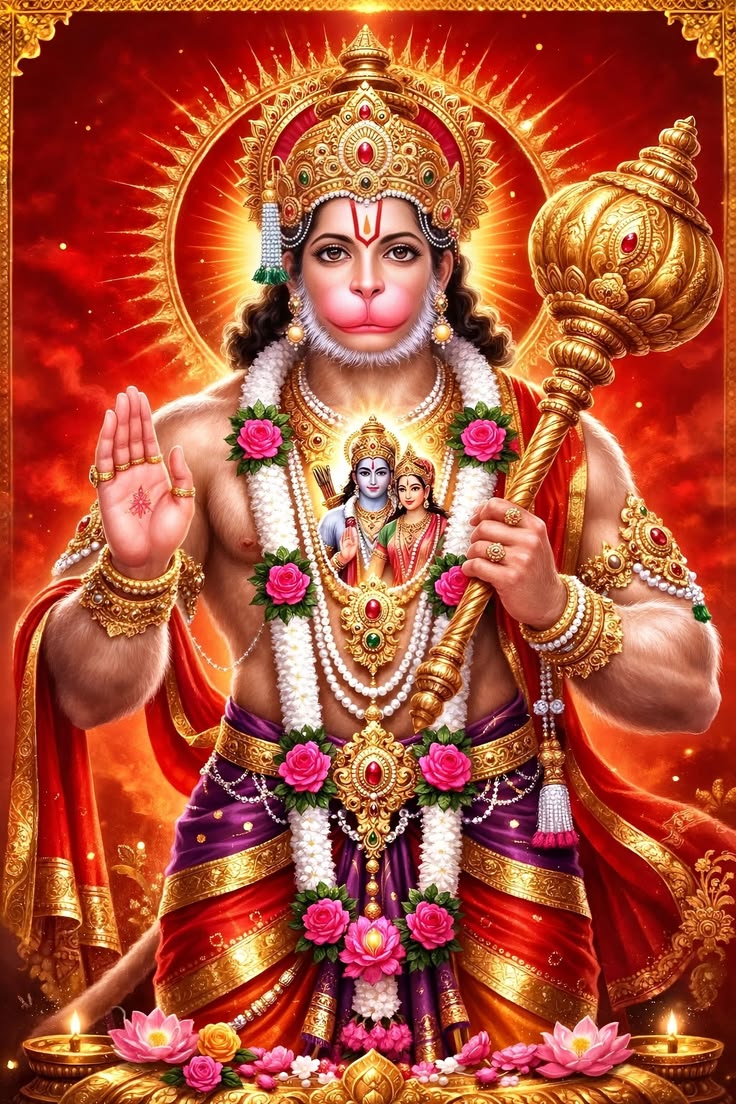
Lord Hanuman is the supreme symbol of Ram devotion, strength, courage, and wisdom in Sanatan Dharma. He is considered the Rudra Avatar — Lord Shiva himself took this form to serve Lord Rama. His mother was Anjani and father was Kesari, the king of vanaras (monkeys), but because of Pavan Dev's (Wind God's) grace at his birth, he is called "Pavan Putra" (Son of the Wind).
Hanuman ji's life is the soul of the Ramayana. He found Mother Sita in Lanka, leaped across the ocean, burned Lanka, brought the Sanjivani mountain, and played a decisive role in the Ram-Ravana war. He is "Chiranjeevi" (immortal) — wherever Ramkatha is told today, Hanuman ji is subtly present.
The greatest message of Hanuman ji's devotion is "surrender and service". He made Rama his everything and used his strength and intellect only for Rama's service. This is why he is called the "Ram-doot" (Rama's messenger) and considered the direct deity who protects from all troubles in the Kali Yuga.
Key Information
- Mother: Anjani
- Father: Kesari (Vanara king)
- Divine Father: Pavan Dev (Wind God)
- Avatar: Rudra Avatar (Shiva)
- Devotion to: Lord Rama
- Birthplace: Anjani Parvat (Karnataka/Jharkhand)
- Status: Chiranjeevi (Immortal)
Major Festivals
- Hanuman Jayanti: Chaitra Purnima
- In South India: Margashirsh Amavasya
- Tuesday: Weekly Hanuman Puja
- Saturday: Hanuman Chalisa recitation
- Ram Navami: As Ram-bhakt
- Dussehra: Helper in Ram's victory
Mantras
Lord Hanuman's mantras are considered extremely powerful — they protect from fear, troubles, planetary doshas, and evil forces. Chanting them on Tuesdays and Saturdays is especially fruitful.
Special Significance
Hanuman ji is called the "Bestower of the Eight Siddhis and Nine Nidhis". He possesses eight siddhis (Anima, Mahima, Garima, Laghima, Prapti, Prakamya, Ishitva, Vashitva) and nine nidhis — which devotees receive through Mother Sita's blessing.
The "Hanuman Chalisa" composed by Tulsidas is the most famous devotional poem of 40 verses (chaupais). It is believed that regular recitation removes all troubles, dispels fear, and grants Rama-bhakti.
Hanuman ji is Chiranjeevi — one of the seven immortal deities. It is believed that he still chants Rama's name in a secret cave in the Himalayas. Wherever Ramkatha is recited, Hanuman ji subtly attends — which is why the tradition is to leave one seat empty during Ramayana recitations.
The Major Stories of Hanuman
The stories of Hanuman ji are filled with courage, devotion, and miracles — here are some of the major ones —
Major Festivals (Detailed)
Festivals associated with Hanuman ji are celebrated with great devotion — Tuesdays and Saturdays are his special days —
Iconography & Qualities
Hanuman ji's iconography is highly symbolic — every feature represents his strength, devotion, and service —
Major Sacred Places
Hanuman ji temples are spread throughout India. Here are four of the most famous and miraculous sites —
Related Scriptures
The glory of Hanuman ji is described in many scriptures. Their recitation removes every obstacle in life —
Frequently Asked Questions
In North India, Hanuman Jayanti is celebrated on Chaitra Purnima (April) — Hanuman ji's birth anniversary. In South India (especially Telangana, Andhra Pradesh), it is celebrated on Margashirsh Amavasya. In Maharashtra, Chaitra Purnima is observed.
The Hanuman Chalisa is a sacred poem of 40 chaupais composed by Goswami Tulsidas. It is believed that regular recitation removes all troubles, dispels fear, calms Shani's affliction, and grants Rama-bhakti. Recitation on Tuesday and Saturday is especially fruitful.
Once Hanuman ji saw Mother Sita applying sindoor in her hair-parting. He asked why, and Sita said "for Lord Rama's long life." Then Hanuman thought that if a little sindoor brings such fruit, applying it to the entire body would make Rama immortal — and he applied sindoor all over his body. From then on, the tradition of offering sindoor to Hanuman ji began.
Yes, Hanuman ji is "Chiranjeevi" — one of the seven immortal beings (Ashwatthama, Bali, Vyasa, Hanuman, Vibhishana, Kripacharya, Parashurama). Rama granted him the boon of immortality. It is believed that he still chants Rama's name in some cave in the Himalayas. Wherever Ramkatha is told, he subtly attends.
Hanuman ji freed Shani from Ravana's bondage. In return, Shani Dev vowed that he would never trouble Hanuman devotees. This is why during Shani's dasha or Sade Sati period, reciting the Hanuman Chalisa or Sundarkand calms Shani's affliction. On Saturday, oil is offered to Hanuman ji.
Hanuman puja at home is simple — after a morning bath, light a lamp (preferably with jasmine oil) before Hanuman's idol/image, offer sindoor, red flowers (hibiscus), and recite Hanuman Chalisa 1, 7, or 11 times. Offer boondi laddoo, chana-gud (chickpeas with jaggery), or besan as bhog. Tuesdays and Saturdays are especially auspicious.
During Ahiravana's kidnapping of Rama-Lakshmana, Hanuman ji assumed a massive form with five faces — Panchmukhi Hanuman. The five faces are — Hanuman (east), Garuda (west), Varaha (north), Narasimha (south), and Hayagriva (upward). This form is considered extremely powerful and protective.
The child Hanuman was hungry, and he tried to swallow the rising sun, mistaking it for a red fruit. Darkness fell upon the entire world. Indra struck him with his vajra, breaking his chin (hanu), and he fell unconscious. When Pavan Dev angrily stopped all wind, all the gods came to bless him. From then on, his name became "Hanuman" (the one with a marked chin).
The Bajrang Baan is an extremely powerful stotra composed by Tulsidas. The word "Baan" (arrow) means that it reaches Hanuman ji directly. It is recited during great distress — for relief from enemies, evil spirits, ill effects of tantra-mantra, and serious illnesses. However, it must be recited with utmost devotion and purity.
At Prayagraj, on the Sangam banks, stands the world-famous "Lete Hanuman ji" (reclining Hanuman) temple. It is believed that after burning Lanka, Hanuman ji was exhausted and rested here at Mother Sita's request. The colossal 20-foot reclining idol is in repose. Even during the rising water levels of the Ganga, the temple remains safe — considered a miracle.
Located in Dausa district of Rajasthan, Mehandipur Balaji temple is world-famous for freedom from ghost-spirit afflictions, tantra-mantra doshas, and mental illnesses. Here, Balaji (Hanuman), Pretraj Sarkar, and Bhairav Baba are worshipped together. There are special rules — the prasad offered at the temple is not taken home, and one does not look back while leaving.
Hanuman ji took a vow of lifelong celibacy for the sake of Rama's devotion. He dedicated his entire life completely to Rama-Sita's service. Although some Puranas mention a son named Makardhwaj, said to have been born from his sweat. Due to celibacy, he possessed extraordinary powers.