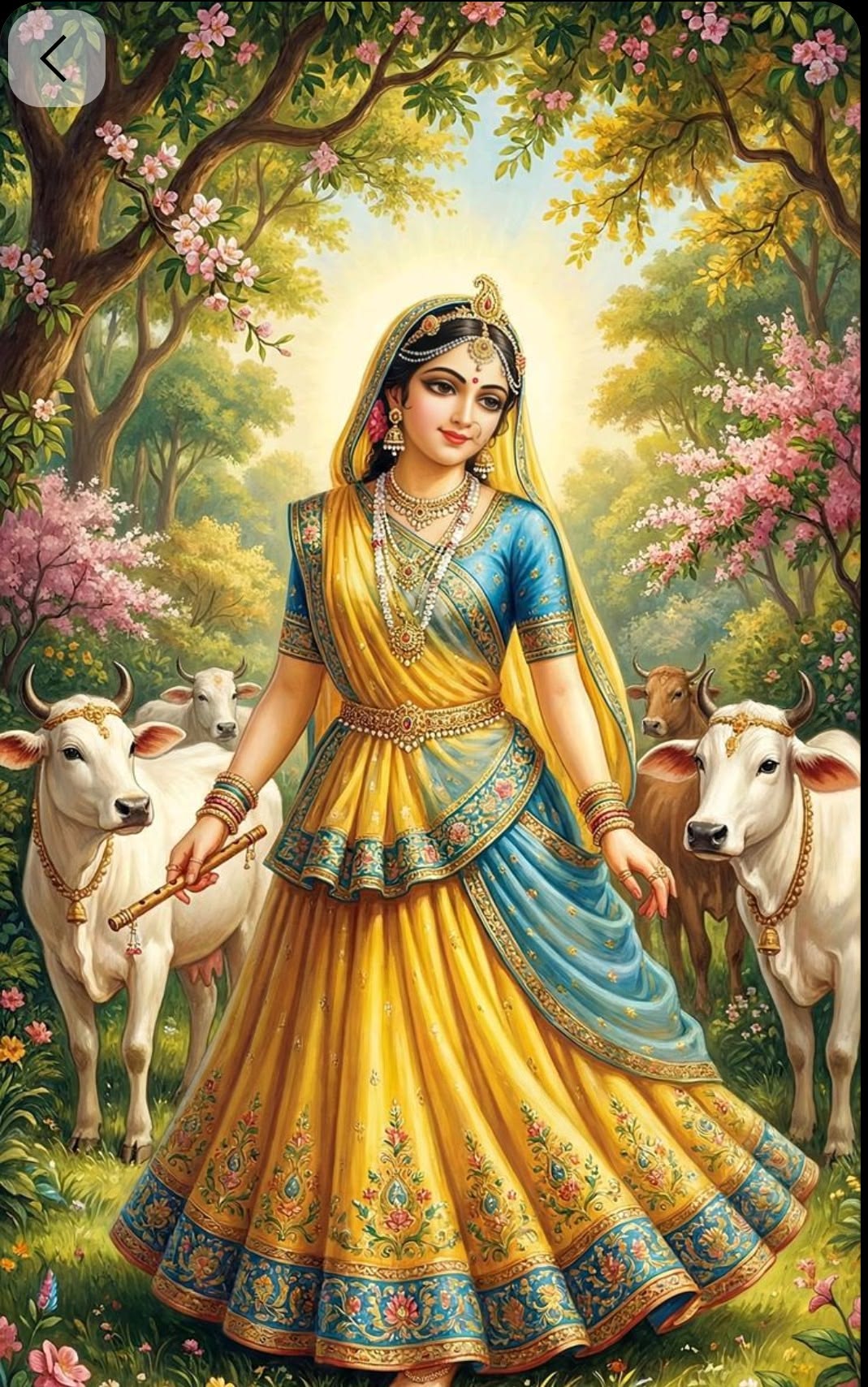
Shri Radha Rani is the supreme embodiment of love, devotion, and divinity in Sanatan Dharma. She is considered the Ahladini Shakti of Lord Krishna — the pleasure-giving energy and the literal manifestation of Krishna's bliss. Radha Rani was born in Rawal village of the Braj region to Father Vrishabhanu Ji and Mother Kirti Devi. Later, her family settled in Barsana, which is famously known as "Ladli Ji's town" to this day.
The love of Radha and Krishna transcends worldly affection — it is the meeting of the soul with the Supreme. In Vaishnava tradition, Radha is given a place even higher than Krishna himself — because Krishna himself chants "Radhe!" Today, the people of Braj greet each other with "Radhe Radhe." Saints and sages say — "Without Radha, even Krishna is incomplete."
Key Information
- Father: Vrishabhanu Ji
- Mother: Kirti Devi
- Birthplace: Rawal village (Mathura)
- Residence: Barsana, Uttar Pradesh
- Eternal Beloved: Lord Shri Krishna
- Region: Braj (Barsana · Vrindavan)
Major Festivals
- Radhashtami: Bhadrapad Shukla Ashtami
- Lathmar Holi: Phalgun (before Holi)
- Sharad Purnima: Raas Leela celebration
- Janmashtami: Worship with Shri Krishna
- Hariyali Teej: Sawan jhula festival
- Govardhan Puja: Kartik month
Mantras
Chanting Radha Rani's divine mantras is the simplest and most powerful path to Krishna devotion. These mantras bring peace to the mind, love to the heart, and supreme bliss to the soul.
Special Significance
The greatest secret of Radha Rani's devotion is selfless love. She never asked Krishna for anything — she only loved. This is why the path of Krishna bhakti is considered incomplete without Radha. The Brahma Vaivarta Purana, Padma Purana, and Garga Samhita all contain detailed accounts of Radha Rani.
Chanting "Radhe Radhe" is considered the simplest path to moksha (liberation) in the Kali Yuga. It is said that Krishna himself experiences supreme bliss upon hearing Radha's name. Chaitanya Mahaprabhu propagated the "Hare Krishna Hare Rama" Mahamantra, which carries within it the divine remembrance of Radha Rani.
The relationship of Radha-Krishna is not merely love — it is the non-dual oneness of soul and supreme soul. Just as the moonlight is inseparable from the moon, Radha is inseparable from Krishna. Together they form the "Radha-Krishna Tattva" — the supreme form of Parabrahman.
The Complete Story of Radha Rani
The story of Radha Rani is connected to the Dwapar Yuga — a wonderful tale of devotion, divine love, and miracles. Let us walk through this sacred journey step by step —
Major Festivals (Detailed)
Radha Rani's festivals are celebrated throughout the Braj region with unparalleled devotion and joy. Each festival commemorates a special leela of Radha-Krishna —
Iconography & Qualities
The iconography of Radha Rani is a symbol of beauty, compassion, and divine love. The following elements are central to her depictions —
Sacred Places
The center of Radha Rani's devotion is primarily the Braj region — Barsana, Vrindavan, and nearby places. The temples here enshrine the yugal (couple) idols of Radha-Krishna, and devotees consider visiting these sacred places to be the supreme blessing of life.
Related Scriptures
The glory of Radha Rani is described in many sacred scriptures. These texts elaborate on Radha-tattva, her leelas, and her divine love with Krishna —
Frequently Asked Questions
Radhashtami is celebrated on Bhadrapad Shukla Ashtami (August-September) — it marks the birth anniversary of Radha Rani. It comes exactly 15 days after Krishna Janmashtami. Barsana hosts a particularly grand celebration. Devotees fast, sing bhajans, and offer the 56 Bhog (a feast of 56 dishes). It is believed that fasting on this day grants the complete fruit of Krishna devotion.
Radha Rani was born in Rawal village in the Braj region (near Mathura-Vrindavan). Her father was Vrishabhanu Ji and her mother was Kirti Devi. Later, the family moved to Barsana, which is still considered the main town of Radha Rani today. The famous "Ladli Ji Temple" stands on Brahmagiri Hill in Barsana.
In the worldly sense, Radha-Krishna did not marry — Krishna was married to Rukmini, Satyabhama, and others. However, spiritually, Radha-Krishna are non-dual — two forms of one soul. The Brahma Vaivarta Purana states that in Goloka (Krishna's divine realm), Radha is Krishna's primary consort, and their wedding was conducted by Lord Brahma himself.
In the Braj region, people greet each other with "Radhe Radhe" — this is not just a greeting, but a remembrance of Radha Rani. It is believed that uttering "Radhe" pleases Krishna himself, because even Krishna chants Radha's name. This is considered the simplest path to moksha (liberation) in the Kali Yuga.
"Ahladini" means "the one who gives bliss." According to Chaitanya Mahaprabhu and the Gaudiya Vaishnava philosophy, Krishna has three primary energies — Sat, Chit, and Ananda. Radha Rani is the embodiment of "Ananda" — the literal manifestation of Krishna's bliss. This is why it is said that without Radha, Krishna is incomplete.
Barsana is Radha Rani's town — her paternal home. The "Ladli Ji's Temple" is the most prominent here. Vrindavan is the center of Krishna's leelas — Banke Bihari, Prem Mandir, Radha Damodar are located here. Together with Mathura, Gokul, Nandgaon, and Govardhan, they form the larger "Braj" region. The complete Braj Parikrama (circumambulation) covers 84 kos (~272 km).
Lathmar Holi is a world-famous tradition celebrated a few days before Holi in Barsana and Nandgaon. The gopis of Barsana (Radha's village) playfully strike the men of Nandgaon (Krishna's village) with lathis (sticks) — the men defend themselves with shields. It is a remembrance of Krishna's playful teasing of Radha and her sakhis.
Worship of Radha Rani at home is simple — after a morning bath, light a lamp before the yugal (Radha-Krishna couple) image, offer yellow flowers, and chant "ॐ ह्रीं श्रीराधिकायै नमः" 108 times. Offer makhan-mishri or panjiri as bhog. Observe a special fast on Radhashtami. Most importantly — simply chanting "Radhe Radhe" is the greatest worship of all.
Radha Rani's Ashta Sakhis (eight friends) are most famous — Lalita, Vishakha, Chitra, Champaklata, Indulekha, Rangadevi, Tungavidya, and Sudevi. Lalita and Vishakha are considered the most prominent. Beyond these, there were thousands of manjaris and gopis. All these sakhis assisted in the divine leelas of Radha-Krishna.
Radha Rani is not directly named in the Bhagavad Gita, as it is a philosophical dialogue during the Kurukshetra war. However, the Brahma Vaivarta Purana, Padma Purana, Garga Samhita, and Bhagavata Mahapurana (Canto 10) contain detailed accounts of Radha Rani. Jayadev's "Gita Govinda" is also a unique poetic work on the divine love of Radha-Krishna.
Barsana is located in the Mathura district of Uttar Pradesh. The nearest railway station is Mathura (≈45 km). From Delhi, it is ≈170 km by road and takes 3-4 hours. You can take NH-19 or the Yamuna Expressway to reach Mathura, then take a taxi or bus to Barsana. There are special crowds during Radhashtami and Holi — advance booking is required.
The greatest message of Radha Rani is — selfless love and surrender. She never asked Krishna for anything; she only loved. Her devotion was so pure that Krishna himself became her servant. This teaches us that true love is unconditional — and when we love God without expectation, God himself becomes ours.