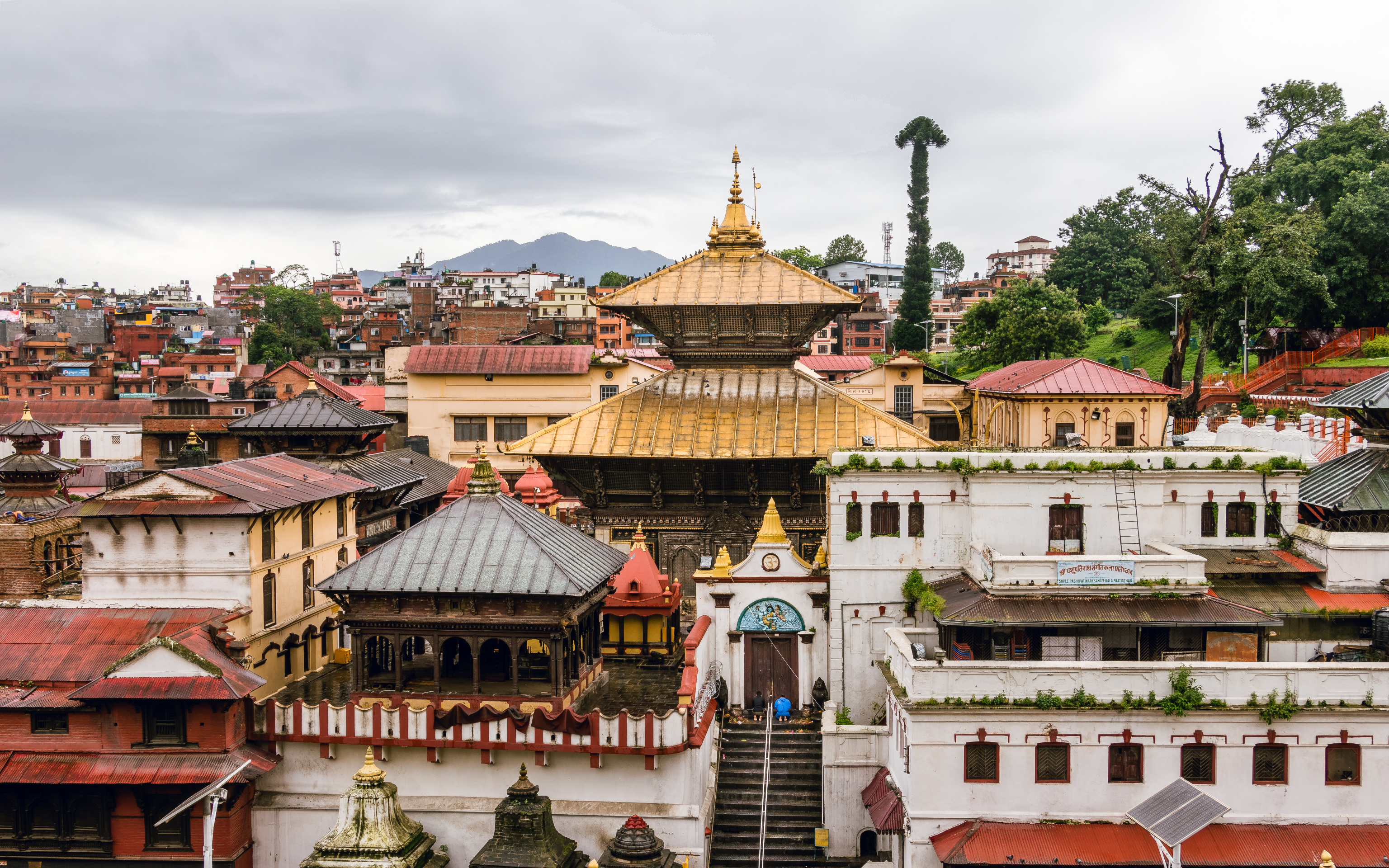
The Pashupatinath Temple is the most sacred and most famous temple in Nepal dedicated to Lord Shiva, situated on the banks of the holy Bagmati river in the capital city of Kathmandu. Here, Lord Shiva is worshipped as "Pashupati" — the Lord of all living beings. The temple is a centre of profound faith for Hindus and holds the status of a UNESCO World Heritage Site.
This world-renowned Shiva shrine — Nepal's only one of its kind — is not merely a single temple but a vast sacred complex of hundreds of shrines, ashrams, dharamshalas and ghats. The sanctum houses a chaturmukha (four-faced) Shiva lingam, and the presence of sadhus and ascetics along the Bagmati ghats lends the place an otherworldly spiritual atmosphere. On Maha Shivratri, lakhs of devotees gather here from both India and Nepal.
Quick Information
- Main Deity: Lord Shiva (Pashupatinath)
- Location: Kathmandu, Nepal
- River: Bagmati (Arya Ghat)
- Form: Chaturmukha (four-faced) lingam
- Style: Nepali Pagoda architecture
- Heritage: UNESCO World Heritage (1979)
Darshan & Aarti Timings
History & Mythology
The history of the Pashupatinath Temple is extremely ancient and finds mention in numerous Puranas and old scriptures. Inscriptions from the Lichchhavi period (around the 5th century CE) have been found here, confirming the temple's antiquity. For centuries, this site has been a centre of the Shaiva tradition and of Nepal's national faith.
According to the most famous legend, Lord Shiva, momentarily weary of the splendour of Varanasi, came to the Sleshmantak forest (Mrigasthali) of the Kathmandu valley and roamed about in the form of a deer (mriga). When the other gods discovered him and tried to seize him, the horn of his deer-form broke and scattered into several pieces. One sacred fragment of this horn was later enshrined and worshipped as the "Pashupati lingam".
Another folk legend tells that in ancient times a cow would daily pour its milk onto a particular mound of its own accord. When the astonished herdsmen dug there, they beheld a divine jyotirlingam — and the worship of Pashupatinath began from that time.
A popular belief links Pashupatinath with Kedarnath. It is said that after the Mahabharata, Lord Shiva dived into the earth in the form of a bull — his hump emerged at Kedarnath, while his face/head appeared at Pashupatinath. For this reason, the two shrines are regarded as complementary pilgrimages.
The present main temple dates to the 17th century (around 1692 CE), when King Bhupalendra Malla had it rebuilt after the older structure was damaged. The Malla and Shah dynasties extended royal patronage to the temple, and Pashupatinath came to be regarded as the guardian (presiding) deity of Nepal. In 1979, the entire complex was inscribed on the UNESCO World Heritage List.
Temple Architecture
The Pashupatinath Temple is a magnificent example of Nepali Pagoda architecture. The main temple is two-tiered (with two roofs), whose roofs are covered in gilded copper and crowned by a golden gajur (pinnacle) at the top. The temple has grand silver-plated doors on all four sides.
The chaturmukha Shiva lingam enshrined in the sanctum has four faces pointing in the four directions, believed to symbolise the various forms of Lord Shiva. A large gold/metal statue of Nandi (the bull) stands facing the temple. The intricate wood carvings and artistic struts (toran) reflect the rich tradition of Nepali craftsmanship.
By tradition, only the "Bhatta" priests originating from South India (Karnataka) have the right to perform worship in the main sanctum — a practice that has continued unbroken for centuries.
Bagmati River & Arya Ghat
The Bagmati river that flows beside the temple is considered extremely sacred and is revered like the Ganga. The ghats built along its banks are centres of spiritual activity.
The Arya Ghat located here is renowned for Hindu cremation rites — it is believed that a cremation near Pashupatinath grants the soul moksha (liberation). The presence of sadhus, aghoris and ascetics on the ghats makes the atmosphere even more mystical and spiritual.
Entry & Rules
- Indian Citizens: Free entry — show an Indian passport or Voter ID at the gate.
- Non-Hindus: Not allowed inside the main sanctum; darshan possible from across the Bagmati.
- Dress Code: Modest clothing required — shoulders and legs must be covered.
- Leather Items: Belts, wallets, shoes and any leather items are prohibited inside.
- Photography: Prohibited inside the sanctum and inner area.
How to Reach
The Pashupatinath Temple is located within Kathmandu city and is easily reached by air and road.
Major Festivals
- Maha Shivratri: The biggest festival — lakhs of devotees and thousands of sadhus gather from India and Nepal.
- Teej (Hartalika Teej): A major fasting festival for married women, drawing huge crowds.
- Bala Chaturdashi: Special rituals for the peace of departed souls.
- Mondays of Shravan: Especially significant for devotees of Lord Shiva.
Accommodation
- Dharamshalas & Ashrams — Budget-friendly stays near the temple complex
- Hotels & Guest Houses — Available across all categories in Thamel and Kathmandu
- Budget Lodges — Many affordable options for Indian pilgrims
- Advance Booking on Festivals — Stays fill up fast during Maha Shivratri
Travel Tips
A few useful tips for a smooth visit —
- Always carry an Indian passport or Voter ID (for free entry)
- For the Mangala Aarti, arrive by 04:30 AM — crowds are lighter
- Leave leather items (belts/wallets) at your hotel
- Maintain sensitivity and silence around the cremation sites on the ghats
- Wear modest clothing — shoulders and legs covered
- Currency exchange and a local SIM are convenient to arrange in Kathmandu
Temple Location
The exact location of Pashupatinath Temple — zoom in on the interactive map below or open it in Google Maps for navigation.
Frequently Asked Questions
The Pashupatinath Temple is dedicated to Lord Shiva, worshipped here as 'Pashupati', the Lord of all living beings. The sanctum houses a chaturmukha (four-faced) Shiva lingam.
Yes, entry is free for Indian citizens. You need to show an Indian passport or Voter ID at the gate.
No, only Hindus are permitted inside the main sanctum. Non-Hindu visitors can view the temple from across the Bagmati river.
Morning darshan is from 04:00 AM to 12:00 PM and evening darshan from 05:00 PM to 09:00 PM. The inner sanctum is closed from 12:00 PM to 05:00 PM, but the outer temple and ghats remain open.
The Mangala (morning) Aarti is held at 05:00 AM and is considered the most sacred — it is best to arrive by 04:30 AM. The Sandhya (evening) Aarti takes place on the ghats around 07:00–07:30 PM.
Modest clothing is required — shoulders and legs should be covered. No leather items (belts, wallets, shoes, etc.) are allowed inside the temple premises.
The temple is about 4 km from Tribhuvan International Airport in Kathmandu. Devotees from India can fly to Kathmandu, or travel by road via the Sunauli/Raxaul border.
According to a popular belief, Lord Shiva dived into the earth in the form of a bull — his hump emerged at Kedarnath and his face/head appeared at Pashupatinath. Hence Pashupatinath is regarded as the complementary shrine to Kedarnath.
Yes, the Pashupatinath Temple complex was inscribed on the UNESCO World Heritage List in 1979 as part of the Kathmandu Valley.
Maha Shivratri is the biggest festival here, when lakhs of devotees and thousands of sadhus gather from India and Nepal. The Teej festival also draws huge crowds of women.
Photography is prohibited inside the main sanctum and inner temple area. It is generally allowed at the Bagmati ghats and outer complex, but please be respectful around the cremation sites.
The Bagmati river flowing beside the temple is considered extremely sacred. The Arya Ghat located here is used for Hindu cremation rites and is believed to be a place that grants moksha (liberation).
Official Website
For darshan, pujas & rituals and official information, please visit the Pashupati Area Development Trust (PADT) website.
pashupatinath.org