
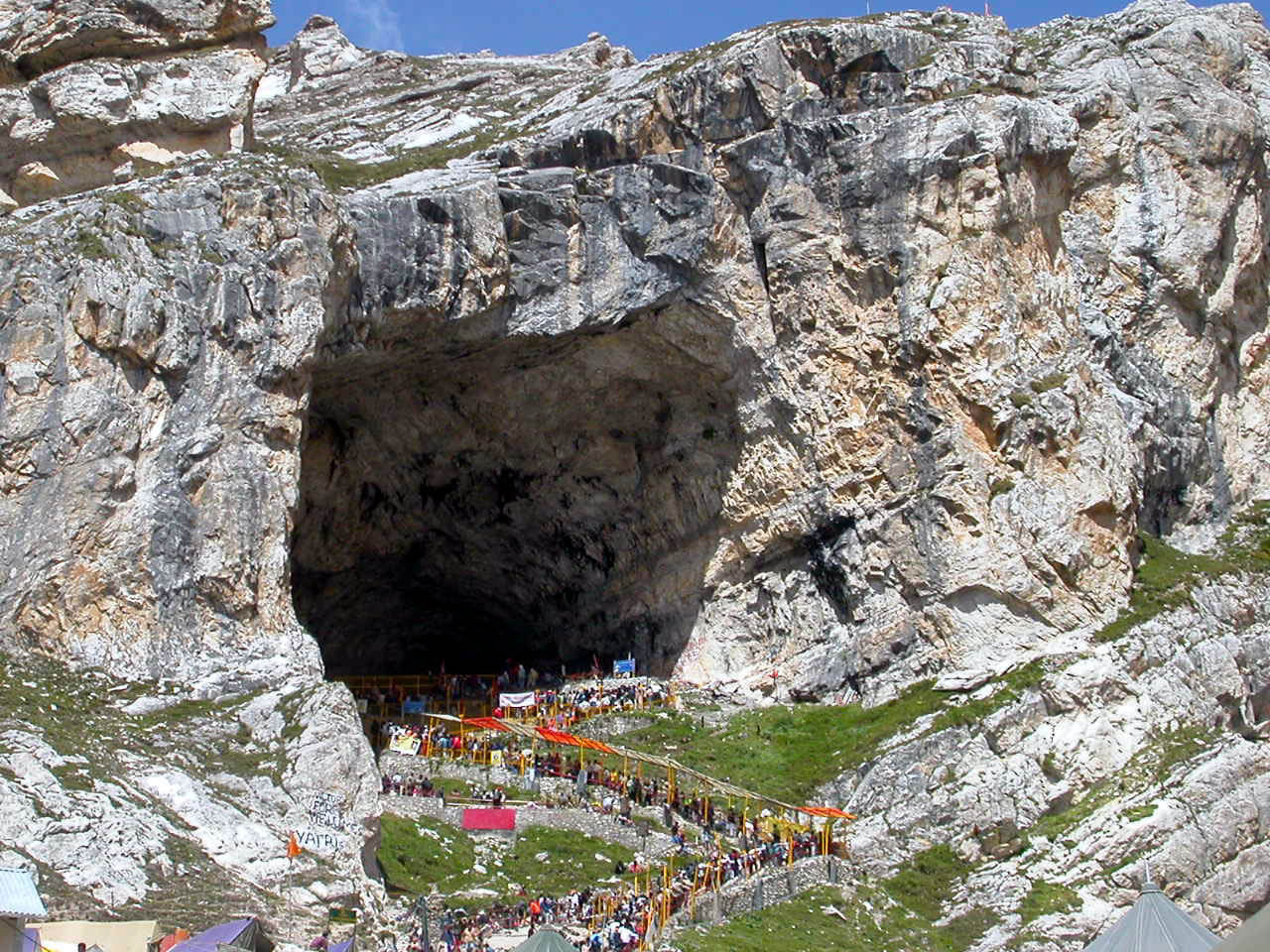
The Shri Amarnath Cave Temple, one of the most sacred and mysterious shrines of Lord Shiva, stands at an altitude of about 3,888 metres amid the Himalayas of Anantnag district, Jammu & Kashmir. This holy cave is world-famous for its self-formed ice Shivling, which forms naturally from ice every year and is believed to wax and wane with the phases of the moon. For this reason, Lord Shiva is lovingly worshipped here as "Baba Barfani".
According to ancient mythology, it was in this very cave that Lord Shiva narrated the secret of immortality — the "Amar Katha" — to Goddess Parvati, which is how the place came to be known as "Amarnath". Every year during the month of Shravan, lakhs of devotees traverse the challenging Himalayan trails to seek the darshan of Baba Barfani. The yatra is regarded as a unique symbol of faith, penance and unwavering devotion.
Quick Information
- Main Deity: Lord Shiva (Baba Barfani / Amareshwar)
- Location: Anantnag, Jammu & Kashmir
- Altitude: 3,888 metres
- Base Camps: Pahalgam / Baltal
- Yatra Begins: Shravan month (July)
- Yatra Ends: Raksha Bandhan / Shravan Purnima (Aug)
Darshan & Aarti Timings
History & Mythology
The legend of the Amarnath Cave is ancient and deeply mysterious. According to mythology, Goddess Parvati expressed her wish to learn the secret of immortality from Lord Shiva. Shiva wished to narrate this secret "Amar Katha" in a place so secluded that no other living being could overhear it — and for this, he chose the cave of Amarnath.
On his way to the cave, Lord Shiva renounced all his worldly belongings — he left Nandi the bull at Pahalgam, the moon at Chandanwari, his serpents at Sheshnag lake, his son Ganesha at Mahagunas peak, and the five elements at Panchtarni. He then narrated the Amar Katha to Parvati in solitude. It is believed that a pair of pigeons sitting nearby overheard the tale and became immortal — even today devotees speak of sighting these pigeons near the cave.
A medieval folk legend tells of the cave being rediscovered by a shepherd named Buta Malik — it is said that a sage gave him a bag of coal which turned into gold when he reached home. Today the shrine is managed by the Shri Amarnathji Shrine Board (SASB), and every year during Shravan, lakhs of pilgrims arrive here for the darshan of Baba Barfani.
How to Reach
There are two main base camps to reach the Amarnath Cave — Pahalgam and Baltal. The final ascent is covered on foot, by pony/mule, palanquin, or helicopter.
Accommodation
- Yatra Camps — Tents and temporary accommodation at Baltal, Chandanwari, Sheshnag and Panchtarni
- Langars & Bhandaras — Free community meals available all along the yatra route
- Hotels & Guest Houses — Plenty of options available at Pahalgam and Srinagar
- Advance Booking Essential — Accommodations fill up quickly during the yatra season
Safety Advice
The Amarnath Yatra is one of the most challenging Himalayan pilgrimages. Due to the high altitude and cold environment, several precautions are essential —
- Registration with the Shri Amarnathji Shrine Board and a Health Certificate (CHC) are mandatory
- Pilgrims with high blood pressure, heart or respiratory issues must consult a doctor first
- If symptoms of altitude sickness (AMS) appear, descend immediately and seek help
- Weather changes rapidly — always check the daily weather bulletin
- Carry warm woollen clothes, a raincoat, trekking shoes and a basic medical kit
- Use only the authorised route; elderly pilgrims should use ponies or palanquins
Temple Location
The exact location of Shri Amarnath Cave Temple — zoom in on the interactive map below or open it in Google Maps for navigation.
Frequently Asked Questions
The Amarnath Yatra is held every year during the month of Shravan (July-August) and usually concludes on Raksha Bandhan / Shravan Purnima. The exact dates are announced annually by the Shri Amarnathji Shrine Board.
The ice Shivling forms naturally from water droplets freezing on the cave floor. It is believed to wax and wane with the phases of the moon, which is why Lord Shiva is lovingly called Baba Barfani here.
There are two main routes — the traditional Pahalgam route (about 36-48 km, relatively easier with a gradual climb) and the Baltal route (about 14 km, shorter but steeper and more challenging).
Yes, helicopter services operate on the Baltal-Panjtarni and Pahalgam-Panjtarni routes (subject to weather). From Panjtarni, the remaining distance to the cave is covered on foot or by pony. Advance booking is required.
Yes, registration through the Shri Amarnathji Shrine Board (SASB) is mandatory. A Compulsory Health Certificate (CHC) issued by an authorised doctor is also required.
Due to the altitude of about 3,888 metres and the cold, low-oxygen environment, the yatra is considered challenging. Travel only with good physical fitness, proper preparation and gradual acclimatization.
The nearest airport is Srinagar International Airport and the nearest major railway station is Jammu Tawi. From there, the Pahalgam or Baltal base camps can be reached by road.
Carry warm woollen clothes, a raincoat, trekking shoes and a basic medical kit. Use only the authorised route, check the daily weather bulletin, and if symptoms of altitude sickness (AMS) appear, descend immediately and seek medical help.
Official Website
For yatra registration, dates and official information, please visit the Shri Amarnathji Shrine Board website.
shriamarnathjishrine.com